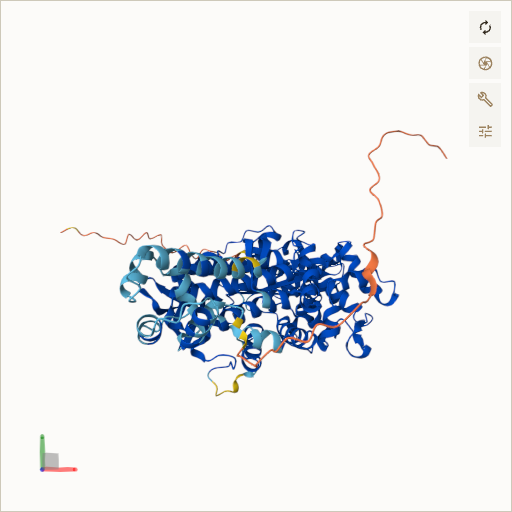
Deoxynucleoside triphosphate triphosphohydrolase SAMHD1
Protein that acts both as a host restriction factor involved in defense response to virus and as a regulator of DNA end resection at stalled replication forks (PubMed:19525956, PubMed:21613998, PubMed:21720370, PubMed:22056990, PubMed:23601106, PubMed:23602554, PubMed:24336198, PubMed:26294762, PubMed:26431200, PubMed:28229507, PubMed:28834754, PubMed:29670289). Has deoxynucleoside triphosphate (dNTPase) activity, which is required to restrict infection by viruses, such as HIV-1: dNTPase activity reduces cellular dNTP levels to levels too low for retroviral reverse transcription to occur, blocking early-stage virus replication in dendritic and other myeloid cells (PubMed:19525956, PubMed:21613998, PubMed:21720370, PubMed:22056990, PubMed:23364794, PubMed:23601106, PubMed:23602554, PubMed:24336198, PubMed:25038827, PubMed:26101257, PubMed:26294762, PubMed:26431200, PubMed:28229507). Likewise, suppresses LINE-1 retrotransposon activity (PubMed:24035396, PubMed:24217394, PubMed:29610582). Not able to restrict infection by HIV-2 virus; because restriction activity is counteracted by HIV-2 viral protein Vpx (PubMed:21613998, PubMed:21720370). In addition to virus restriction, dNTPase activity acts as a regulator of DNA precursor pools by regulating dNTP pools (PubMed:23858451). Phosphorylation at Thr-592 acts as a switch to control dNTPase-dependent and -independent functions: it inhibits dNTPase activity and ability to restrict infection by viruses, while it promotes DNA end resection at stalled replication forks (PubMed:23601106, PubMed:23602554, PubMed:29610582, PubMed:29670289). Functions during S phase at stalled DNA replication forks to promote the resection of gapped or reversed forks: acts by stimulating the exonuclease activity of MRE11, activating the ATR-CHK1 pathway and allowing the forks to restart replication (PubMed:29670289). Its ability to promote degradation of nascent DNA at stalled replication forks is required to prevent induction of type I interferons, thereby preventing chronic inflammation (PubMed:27477283, PubMed:29670289). Ability to promote DNA end resection at stalled replication forks is independent of dNTPase activity (PubMed:29670289). Enhances immunoglobulin hypermutation in B-lymphocytes by promoting transversion mutation (By similarity)