
AlphaFold predicted structure
SDHD · O14521
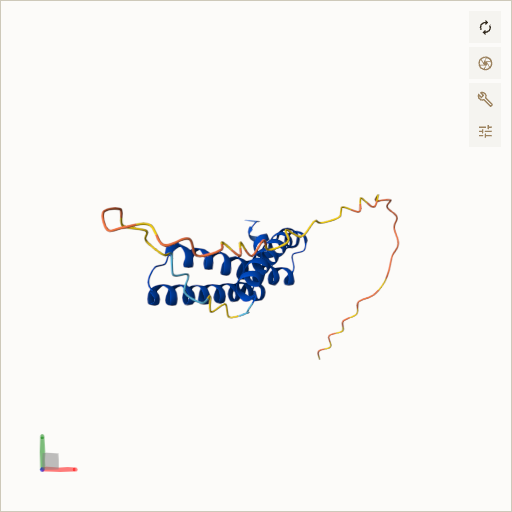
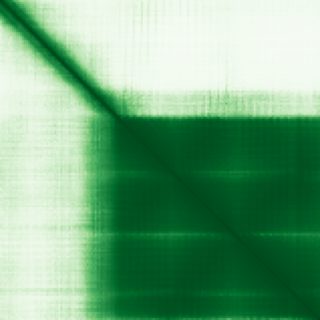
Mean pLDDT
81.7/ 100
Confident
159 residues
Confidence breakdown
- Very high(≥ 90)63%
- Confident(70–90)4%
- Low(50–70)16%
- Very low(< 50)16%
Open interactive 3D viewer
AlphaFold (Jumper et al., 2021) · CC BY 4.0
succinate dehydrogenase complex subunit D
Annotations refreshed 2 months ago.
Diagnostic Grade (Green)
Adult solid tumours cancer susceptibility
MONOALLELIC, autosomal or pseudoautosomal, imprinted status unknownAdult solid tumours for rare disease
MONOALLELIC, autosomal or pseudoautosomal, imprinted status unknownInherited phaeochromocytoma and paraganglioma
MONOALLELIC, autosomal or pseudoautosomal, maternally imprinted (paternal allele expressed)Inherited phaeochromocytoma and paraganglioma excluding NF1
MONOALLELIC, autosomal or pseudoautosomal, maternally imprinted (paternal allele expressed)Inherited predisposition to GIST
MONOALLELIC, autosomal or pseudoautosomal, imprinted status unknownLikely inborn error of metabolism
BIALLELIC, autosomal or pseudoautosomalMitochondrial disorder with complex II deficiency
BIALLELIC, autosomal or pseudoautosomalMitochondrial disorders
BIALLELIC, autosomal or pseudoautosomal+16 more panels — install the extension to see the full list inline on any page.
pheochromocytoma/paraganglioma syndrome 1
hereditary pheochromocytoma-paraganglioma
paragangliomas with sensorineural hearing loss
Carney-Stratakis syndrome
pheochromocytoma
mitochondrial complex 2 deficiency, nuclear type 3
Cowden syndrome 3
mitochondrial complex II deficiency, nuclear type 1
Cowden disease
Inherited cancer-predisposing syndrome
Score is the Open Targets composite evidence score (0-1). Higher = stronger gene-disease association.
Succinate dehydrogenase [ubiquinone] cytochrome b small subunit, mitochondrial
Membrane-anchoring subunit of succinate dehydrogenase (SDH) that is involved in complex II of the mitochondrial electron transport chain and is responsible for transferring electrons from succinate to ubiquinone (coenzyme Q) (PubMed:10482792, PubMed:9533030). SDH also oxidizes malate to the non-canonical enol form of oxaloacetate, enol-oxaloacetate (By similarity). Enol-oxaloacetate, which is a potent inhibitor of the succinate dehydrogenase activity, is further isomerized into keto-oxaloacetate (By similarity)
SDHD · O14521
Mean pLDDT
81.7/ 100
Confident
159 residues
Confidence breakdown
AlphaFold (Jumper et al., 2021) · CC BY 4.0