
AlphaFold predicted structure
SHH · Q15465
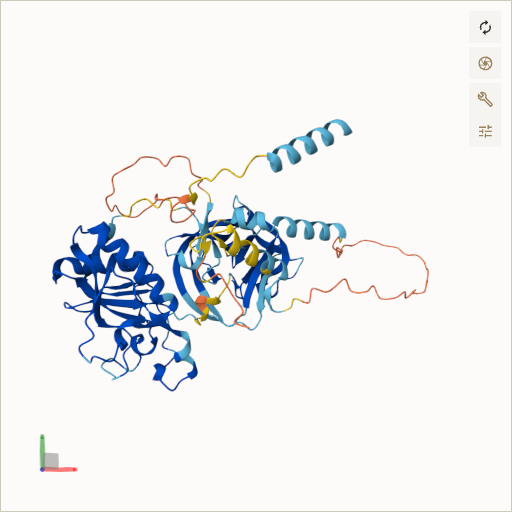
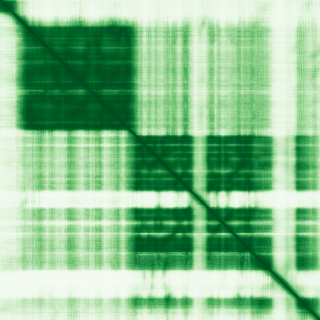
Mean pLDDT
78.4/ 100
Confident
462 residues
Confidence breakdown
- Very high(≥ 90)47%
- Confident(70–90)27%
- Low(50–70)10%
- Very low(< 50)17%
Open interactive 3D viewer
AlphaFold (Jumper et al., 2021) · CC BY 4.0
sonic hedgehog signaling molecule
Annotations refreshed 3 months ago.
Diagnostic Grade (Green)
Anophthalmia or microphthalmia
MONOALLELIC, autosomal or pseudoautosomal, imprinted status unknownClefting
MONOALLELIC, autosomal or pseudoautosomal, imprinted status unknownDDG2P
MONOALLELIC, autosomal or pseudoautosomal, imprinted status unknownFetal anomalies
MONOALLELIC, autosomal or pseudoautosomal, imprinted status unknownHoloprosencephaly
MONOALLELIC, autosomal or pseudoautosomal, imprinted status unknownIntellectual disability
MONOALLELIC, autosomal or pseudoautosomal, NOT imprintedStructural eye disease
MONOALLELIC, autosomal or pseudoautosomal, imprinted status unknownPituitary hormone deficiency
MONOALLELIC, autosomal or pseudoautosomal, imprinted status unknown+9 more panels — install the extension to see the full list inline on any page.
holoprosencephaly 3
holoprosencephaly
solitary median maxillary central incisor syndrome
microphthalmia, isolated, with coloboma 5
Solitary median maxillary central incisor
Triphalangeal thumb - polysyndactyly syndrome
schizencephaly
triphalangeal thumb-polysyndactyly syndrome
polydactyly of a triphalangeal thumb
microphthalmia, isolated, with coloboma
Score is the Open Targets composite evidence score (0-1). Higher = stronger gene-disease association.
Sonic hedgehog protein
Precursor of sonic hedgehog, a morphogen that activates the smoothened signaling pathway, and which is essential for a variety of patterning events during development (PubMed:29954986, PubMed:29995851, PubMed:30139912, PubMed:31127104, PubMed:31548691). The C-terminal part of the precursor displays an autoproteolysis and a cholesterol transferase activity, resulting (1) in the cleavage of the full-length protein into two parts, Sonic hedgehog protein N-product and C-product (ShhN and ShhC, respectively) and (2) covalent attachment of a cholesterol moiety to the C-terminus of the newly generated ShhN (By similarity). Both autoproteolysis and a cholesterol transferase activities occur in the endoplasmic reticulum (By similarity). Following additional lipidation, ShhN acts as a morphogen, while ShhC is degraded in the endoplasmic reticulum (By similarity)
SHH · Q15465
Mean pLDDT
78.4/ 100
Confident
462 residues
Confidence breakdown
AlphaFold (Jumper et al., 2021) · CC BY 4.0