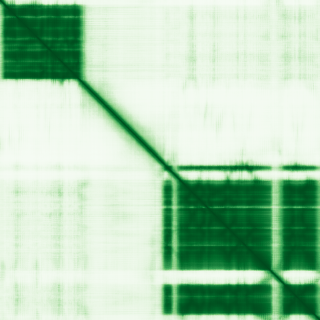
AlphaFold predicted structure
SMAD4 · Q13485
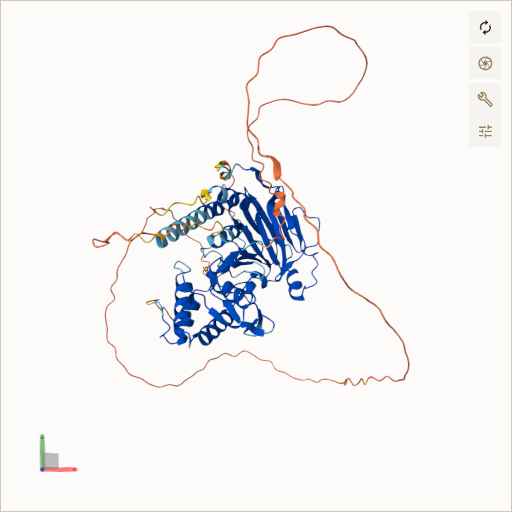

Mean pLDDT
73.4/ 100
Confident
552 residues
Confidence breakdown
- Very high(≥ 90)50%
- Confident(70–90)13%
- Low(50–70)5%
- Very low(< 50)33%
AlphaFold (Jumper et al., 2021) · CC BY 4.0
SMAD family member 4
Annotations refreshed 1 month ago.
Diagnostic Grade (Green)
Adult solid tumours cancer susceptibility
MONOALLELIC, autosomal or pseudoautosomal, imprinted status unknownAdult solid tumours for rare disease
MONOALLELIC, autosomal or pseudoautosomal, imprinted status unknownArthrogryposis
MONOALLELIC, autosomal or pseudoautosomal, NOT imprintedCerebral vascular malformations
MONOALLELIC, autosomal or pseudoautosomal, NOT imprintedChildhood solid tumours
MONOALLELIC, autosomal or pseudoautosomal, imprinted status unknownChildhood solid tumours cancer susceptibility
MONOALLELIC, autosomal or pseudoautosomal, imprinted status unknownClefting
MONOALLELIC, autosomal or pseudoautosomal, imprinted status unknownColorectal cancer pertinent cancer susceptibility
MONOALLELIC, autosomal or pseudoautosomal, NOT imprinted+15 more panels — install the extension to see the full list inline on any page.
juvenile polyposis syndrome
juvenile polyposis/hereditary hemorrhagic telangiectasia syndrome
Myhre syndrome
generalized juvenile polyposis/juvenile polyposis coli
familial pancreatic carcinoma
familial thoracic aortic aneurysm and aortic dissection
colorectal adenocarcinoma
pancreatic adenocarcinoma
hereditary hemorrhagic telangiectasia
Inherited cancer-predisposing syndrome
Score is the Open Targets composite evidence score (0-1). Higher = stronger gene-disease association.
SMAD family member 4
In muscle physiology, plays a central role in the balance between atrophy and hypertrophy. When recruited by MSTN, promotes atrophy response via phosphorylated SMAD2/4. MSTN decrease causes SMAD4 release and subsequent recruitment by the BMP pathway to promote hypertrophy via phosphorylated SMAD1/5/8. Acts synergistically with SMAD1 and YY1 in bone morphogenetic protein (BMP)-mediated cardiac-specific gene expression. Binds to SMAD binding elements (SBEs) (5'-GTCT/AGAC-3') within BMP response element (BMPRE) of cardiac activating regions (By similarity). Common SMAD (co-SMAD) is the coactivator and mediator of signal transduction by TGF-beta (transforming growth factor). Component of the heterotrimeric SMAD2/SMAD3-SMAD4 complex that forms in the nucleus and is required for the TGF-mediated signaling (PubMed:25514493). Promotes binding of the SMAD2/SMAD4/FAST-1 complex to DNA and provides an activation function required for SMAD1 or SMAD2 to stimulate transcription. Component of the multimeric SMAD3/SMAD4/JUN/FOS complex which forms at the AP1 promoter site; required for synergistic transcriptional activity in response to TGF-beta. May act as a tumor suppressor. Positively regulates PDPK1 kinase activity by stimulating its dissociation from the 14-3-3 protein YWHAQ which acts as a negative regulator
Curated MONDO disease pages that list SMAD4 among their top associated genes.
SMAD4 · Q13485


Mean pLDDT
73.4/ 100
Confident
552 residues
Confidence breakdown
AlphaFold (Jumper et al., 2021) · CC BY 4.0