
AlphaFold predicted structure
SMARCC2 · Q8TAQ2
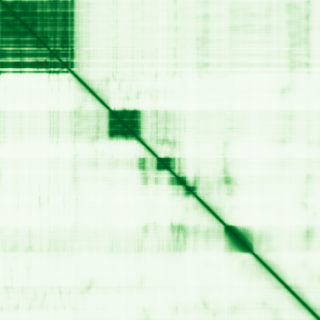
Mean pLDDT
63.4/ 100
Low
1,214 residues
Confidence breakdown
- Very high(≥ 90)28%
- Confident(70–90)19%
- Low(50–70)9%
- Very low(< 50)44%
Open interactive 3D viewer
AlphaFold (Jumper et al., 2021) · CC BY 4.0
SWI/SNF related BAF chromatin remodeling complex subunit C2
Annotations refreshed 2 months ago.
Diagnostic Grade (Green)
DDG2P
MONOALLELIC, autosomal or pseudoautosomal, imprinted status unknownEarly onset or syndromic epilepsy
MONOALLELIC, autosomal or pseudoautosomal, imprinted status unknownFetal anomalies
MONOALLELIC, autosomal or pseudoautosomal, NOT imprintedIntellectual disability
MONOALLELIC, autosomal or pseudoautosomal, imprinted status unknownCoffin-Siris syndrome 8
Intellectual disability
Coffin-Siris syndrome
Global developmental delay
neurodegenerative disease
Neurodevelopmental delay
hereditary disease
neurodevelopmental disorder
Coffin-Siris syndrome 1
osteoarthritis
Score is the Open Targets composite evidence score (0-1). Higher = stronger gene-disease association.
SWI/SNF complex subunit SMARCC2
Involved in transcriptional activation and repression of select genes by chromatin remodeling (alteration of DNA-nucleosome topology). Component of SWI/SNF chromatin remodeling complexes that carry out key enzymatic activities, changing chromatin structure by altering DNA-histone contacts within a nucleosome in an ATP-dependent manner (PubMed:11018012). Can stimulate the ATPase activity of the catalytic subunit of these complexes (PubMed:10078207). May be required for CoREST dependent repression of neuronal specific gene promoters in non-neuronal cells (PubMed:12192000). Belongs to the neural progenitors-specific chromatin remodeling complex (npBAF complex) and the neuron-specific chromatin remodeling complex (nBAF complex). During neural development a switch from a stem/progenitor to a postmitotic chromatin remodeling mechanism occurs as neurons exit the cell cycle and become committed to their adult state. The transition from proliferating neural stem/progenitor cells to postmitotic neurons requires a switch in subunit composition of the npBAF and nBAF complexes. As neural progenitors exit mitosis and differentiate into neurons, npBAF complexes which contain ACTL6A/BAF53A and PHF10/BAF45A, are exchanged for homologous alternative ACTL6B/BAF53B and DPF1/BAF45B or DPF3/BAF45C subunits in neuron-specific complexes (nBAF). The npBAF complex is essential for the self-renewal/proliferative capacity of the multipotent neural stem cells. The nBAF complex along with CREST plays a role regulating the activity of genes essential for dendrite growth (By similarity). Critical regulator of myeloid differentiation, controlling granulocytopoiesis and the expression of genes involved in neutrophil granule formation (By similarity)
SMARCC2 · Q8TAQ2
Mean pLDDT
63.4/ 100
Low
1,214 residues
Confidence breakdown
AlphaFold (Jumper et al., 2021) · CC BY 4.0