
AlphaFold predicted structure
STAC3 · Q96MF2
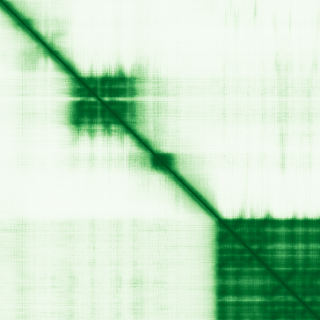
Mean pLDDT
69.3/ 100
Low
364 residues
Confidence breakdown
- Very high(≥ 90)33%
- Confident(70–90)20%
- Low(50–70)17%
- Very low(< 50)31%
Open interactive 3D viewer
AlphaFold (Jumper et al., 2021) · CC BY 4.0
SH3 and cysteine rich domain 3
Annotations refreshed 3 months ago.
Diagnostic Grade (Green)
Arthrogryposis
BIALLELIC, autosomal or pseudoautosomalCongenital myopathy
BIALLELIC, autosomal or pseudoautosomalDDG2P
BIALLELIC, autosomal or pseudoautosomalFetal anomalies
BIALLELIC, autosomal or pseudoautosomalMalignant hyperthermia
BIALLELIC, autosomal or pseudoautosomalNative American myopathy
Bailey-Bloch congenital myopathy
hereditary disease
congenital myopathy
Congenital myasthenic syndromes
congenital myasthenic syndromes with glycosylation defect
amyotrophic lateral sclerosis
Postsynaptic congenital myasthenic syndromes
Distal myopathy, Nonaka type
autosomal recessive limb-girdle muscular dystrophy type 2P
Score is the Open Targets composite evidence score (0-1). Higher = stronger gene-disease association.
SH3 and cysteine-rich domain-containing protein 3
Required for normal excitation-contraction coupling in skeletal muscle and for normal muscle contraction in response to membrane depolarization. Required for normal Ca(2+) release from the sarcplasmic reticulum, which ultimately leads to muscle contraction. Probably functions via its effects on muscle calcium channels (PubMed:23736855, PubMed:29078335). Increases CACNA1S channel activity, in addition to its role in enhancing the expression of CACNA1S at the cell membrane. Has a redundant role in promoting the expression of the calcium channel CACNA1S at the cell membrane (By similarity). Slows down the inactivation rate of the calcium channel CACNA1C (PubMed:29078335)
STAC3 · Q96MF2
Mean pLDDT
69.3/ 100
Low
364 residues
Confidence breakdown
AlphaFold (Jumper et al., 2021) · CC BY 4.0