AlphaFold predicted structure
TNFAIP3 · P21580
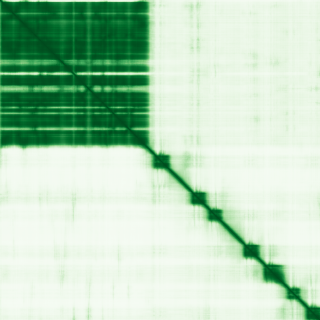
Mean pLDDT
73.8/ 100
Confident
790 residues
Confidence breakdown
- Very high(≥ 90)35%
- Confident(70–90)30%
- Low(50–70)10%
- Very low(< 50)24%
AlphaFold (Jumper et al., 2021) · CC BY 4.0
TNF alpha induced protein 3
Annotations refreshed 1 month ago.
Diagnostic Grade (Green)
Autoinflammatory disorders
MONOALLELIC, autosomal or pseudoautosomal, imprinted status unknownCOVID-19 research
MONOALLELIC, autosomal or pseudoautosomal, imprinted status unknownPrimary immunodeficiency or monogenic inflammatory bowel disease
MONOALLELIC, autosomal or pseudoautosomal, imprinted status unknownPeriodic fever syndromes
MONOALLELIC, autosomal or pseudoautosomal, imprinted status unknownFamilial Meniere Disease
autoinflammatory syndrome, familial, Behcet-like 1
autoinflammatory syndrome, familial, Behcet-like
psoriasis
systemic lupus erythematosus
familial Behcet-like autoinflammatory syndrome
diffuse large B-cell lymphoma
rheumatoid arthritis
psoriasis vulgaris
autoimmune lymphoproliferative syndrome
asthma
Score is the Open Targets composite evidence score (0-1). Higher = stronger gene-disease association.
Tumor necrosis factor alpha-induced protein 3
Ubiquitin-editing enzyme that contains both ubiquitin ligase and deubiquitinase activities. Involved in immune and inflammatory responses signaled by cytokines, such as TNF and IL-1 beta, or pathogens via Toll-like receptors (TLRs) through terminating NF-kappa-B activity. Essential component of a ubiquitin-editing protein complex, comprising also RNF11, ITCH and TAX1BP1, that ensures the transient nature of inflammatory signaling pathways. In cooperation with TAX1BP1 promotes disassembly of E2-E3 ubiquitin protein ligase complexes in IL-1R and TNFR-1 pathways; affected are at least E3 ligases TRAF6, TRAF2 and BIRC2, and E2 ubiquitin-conjugating enzymes UBE2N and UBE2D3. In cooperation with TAX1BP1 promotes ubiquitination of UBE2N and proteasomal degradation of UBE2N and UBE2D3. Upon TNF stimulation, deubiquitinates 'Lys-63'-polyubiquitin chains on RIPK1 and catalyzes the formation of 'Lys-48'-polyubiquitin chains. This leads to RIPK1 proteasomal degradation and consequently termination of the TNF- or LPS-mediated activation of NF-kappa-B. Deubiquitinates TRAF6 probably acting on 'Lys-63'-linked polyubiquitin. Upon T-cell receptor (TCR)-mediated T-cell activation, deubiquitinates 'Lys-63'-polyubiquitin chains on MALT1 thereby mediating disassociation of the CBM (CARD11:BCL10:MALT1) and IKK complexes and preventing sustained IKK activation. Deubiquitinates NEMO/IKBKG; the function is facilitated by TNIP1 and leads to inhibition of NF-kappa-B activation. Upon stimulation by bacterial peptidoglycans, probably deubiquitinates RIPK2. Can also inhibit I-kappa-B-kinase (IKK) through a non-catalytic mechanism which involves polyubiquitin; polyubiquitin promotes association with IKBKG and prevents IKK MAP3K7-mediated phosphorylation. Targets TRAF2 for lysosomal degradation. In vitro able to deubiquitinate 'Lys-11'-, 'Lys-48'- and 'Lys-63' polyubiquitin chains. Inhibitor of programmed cell death. Has a role in the function of the lymphoid system. Required for LPS-induced production of pro-inflammatory cytokines and IFN beta in LPS-tolerized macrophages
Curated MONDO disease pages that list TNFAIP3 among their top associated genes.
TNFAIP3 · P21580

Mean pLDDT
73.8/ 100
Confident
790 residues
Confidence breakdown
AlphaFold (Jumper et al., 2021) · CC BY 4.0