
AlphaFold predicted structure
TREX1 · Q9NSU2
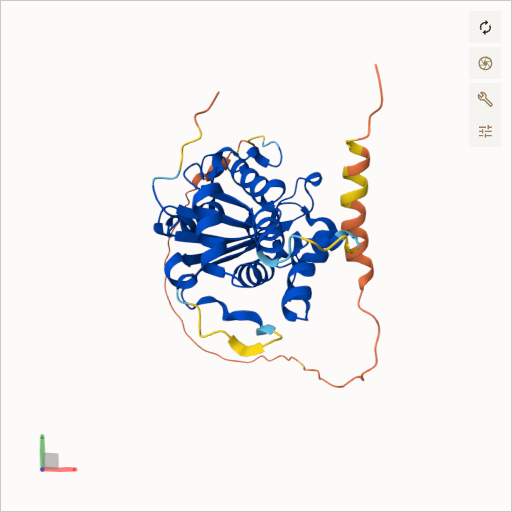
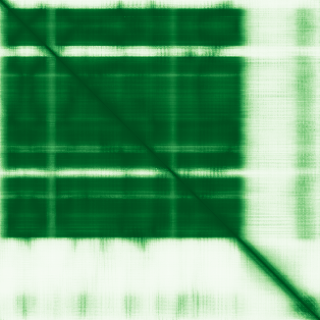
Mean pLDDT
80.3/ 100
Confident
314 residues
Confidence breakdown
- Very high(≥ 90)65%
- Confident(70–90)4%
- Low(50–70)8%
- Very low(< 50)23%
Open interactive 3D viewer
AlphaFold (Jumper et al., 2021) · CC BY 4.0
three prime repair exonuclease 1
Annotations refreshed 2 months ago.
Diagnostic Grade (Green)
Adult onset leukodystrophy
BOTH monoallelic and biallelic, autosomal or pseudoautosomalAdult onset neurodegenerative disorder
BOTH monoallelic and biallelic, autosomal or pseudoautosomalChildhood onset dystonia, chorea or related movement disorder
BOTH monoallelic and biallelic (but BIALLELIC mutations cause a more SEVERE disease form), autosomal or pseudoautosomalCOVID-19 research
BOTH monoallelic and biallelic, autosomal or pseudoautosomalDDG2P
BIALLELIC, autosomal or pseudoautosomalEarly onset or syndromic epilepsy
BOTH monoallelic and biallelic (but BIALLELIC mutations cause a more SEVERE disease form), autosomal or pseudoautosomalFamilial cerebral small vessel disease
BOTH monoallelic and biallelic, autosomal or pseudoautosomalFetal anomalies
BIALLELIC, autosomal or pseudoautosomal+13 more panels — install the extension to see the full list inline on any page.
Aicardi-Goutieres syndrome 1
retinal vasculopathy with cerebral leukoencephalopathy and systemic manifestations
systemic lupus erythematosus
chilblain lupus 1
Aicardi-Goutières syndrome
Cerebroretinal vasculopathy
HERNS syndrome
Hereditary vascular retinopathy
Retinal vasculopathy and cerebral leukodystrophy
chilblain lupus
Score is the Open Targets composite evidence score (0-1). Higher = stronger gene-disease association.
Three-prime repair exonuclease 1
Major cellular 3'-to-5' DNA exonuclease which digests single-stranded DNA (ssDNA) and double-stranded DNA (dsDNA) with mismatched 3' termini (PubMed:10391904, PubMed:10393201, PubMed:17293595). Prevents cell-intrinsic initiation of autoimmunity (PubMed:10391904, PubMed:10393201, PubMed:17293595). Acts by metabolizing DNA fragments from endogenous retroelements, including L1, LTR and SINE elements (PubMed:10391904, PubMed:10393201, PubMed:17293595). Plays a key role in degradation of DNA fragments at cytosolic micronuclei arising from genome instability: its association with the endoplasmic reticulum membrane directs TREX1 to ruptured micronuclei, leading to micronuclear DNA degradation (PubMed:33476576). Micronuclear DNA degradation is required to limit CGAS activation and subsequent inflammation (PubMed:33476576). Unless degraded, these DNA fragments accumulate in the cytosol and activate the cGAS-STING innate immune signaling, leading to the production of type I interferon (PubMed:33476576). Prevents chronic ATM-dependent checkpoint activation, by processing ssDNA polynucleotide species arising from the processing of aberrant DNA replication intermediates (PubMed:18045533). Inefficiently degrades oxidized DNA, such as that generated upon antimicrobial reactive oxygen production or upon absorption of UV light (PubMed:23993650). During GZMA-mediated cell death, contributes to DNA damage in concert with NME1 (PubMed:16818237). NME1 nicks one strand of DNA and TREX1 removes bases from the free 3' end to enhance DNA damage and prevent DNA end reannealing and rapid repair (PubMed:16818237)
Curated MONDO disease pages that list TREX1 among their top associated genes.
TREX1 · Q9NSU2
Mean pLDDT
80.3/ 100
Confident
314 residues
Confidence breakdown
AlphaFold (Jumper et al., 2021) · CC BY 4.0