Skip to content
GenoLensGenoLens

TRIM32

Chr 9q33.1

tripartite motif containing 32

Aliases:
HT2A, TATIP, BBS11
MANE:
ENST00000450136.2

Annotations refreshed 8 hours ago.

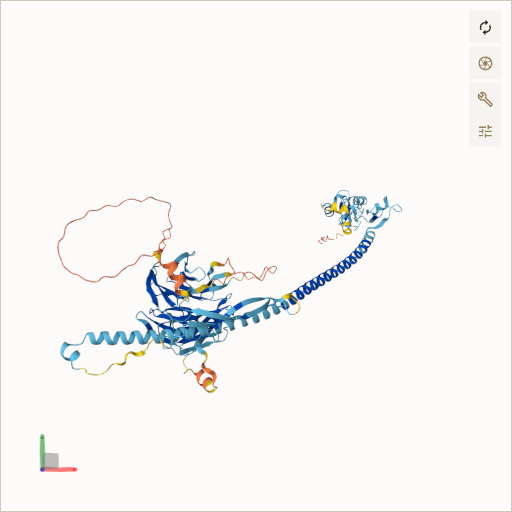
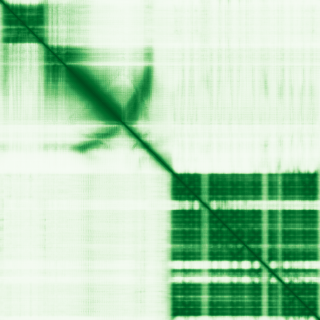
Predicted protein structure

Clinical relevance (Genomics England PanelApp)

Diagnostic Grade (Green)

  • DDG2P

    BIALLELIC, autosomal or pseudoautosomal
  • Limb girdle muscular dystrophies, myofibrillar myopathies and distal myopathies

    BIALLELIC, autosomal or pseudoautosomal
  • Fetal anomalies

    BIALLELIC, autosomal or pseudoautosomal
  • Arthrogryposis

    BIALLELIC, autosomal or pseudoautosomal
  • Bardet Biedl syndrome

    BIALLELIC, autosomal or pseudoautosomal
  • Congenital myopathy

    BIALLELIC, autosomal or pseudoautosomal
  • Cystic kidney disease

  • Glaucoma (developmental)

+13 more panels — install the extension to see the full list inline on any page.

Disease associations (Open Targets)

  • autosomal recessive limb-girdle muscular dystrophy type 2H

    0.78
  • Bardet-Biedl syndrome 11

    0.69
  • Bardet-Biedl syndrome

    0.65
  • autosomal recessive limb-girdle muscular dystrophy

    0.59
  • limb-girdle muscular dystrophy

    0.49
  • Retinal dystrophy

    0.39
  • Bardet-Biedl syndrome 1

    0.37
  • Elevated circulating creatine kinase concentration

    0.35
  • myopathy

    0.35
  • Abnormality of the skeletal system

    0.27

Score is the Open Targets composite evidence score (0-1). Higher = stronger gene-disease association.

Protein function (UniProt)

E3 ubiquitin-protein ligase TRIM32

E3 ubiquitin ligase that plays a role in various biological processes including neural stem cell differentiation, innate immunity, inflammatory resonse and autophagy (PubMed:19349376, PubMed:31123703, PubMed:40793792). Plays a role in virus-triggered induction of IFN-beta and TNF by mediating the ubiquitination of STING1. Mechanistically, targets STING1 for 'Lys-63'-linked ubiquitination which promotes the interaction of STING1 with TBK1 (PubMed:22745133). Regulates bacterial clearance and promotes autophagy in Mycobacterium tuberculosis-infected macrophages (PubMed:37543647). Negatively regulates TLR3/4-mediated innate immune and inflammatory response by triggering the autophagic degradation of TICAM1 in an E3 activity-independent manner (PubMed:28898289). Plays an essential role in oxidative stress induced cell death by inducing loss of transmembrane potential and enhancing mitochondrial reactive oxygen species (ROS) production during oxidative stress conditions (PubMed:32918979). Ubiquitinates XIAP and targets it for proteasomal degradation (PubMed:21628460). Ubiquitinates DTNBP1 (dysbindin) and promotes its degradation (PubMed:19349376). May ubiquitinate BBS2 (PubMed:22500027). Ubiquitinates PIAS4/PIASY and promotes its degradation in keratinocytes treated with UVB and TNF (By similarity). Also acts as a regulator of autophagy by mediating formation of unanchored 'Lys-63'-linked polyubiquitin chains that activate ULK1: interaction with AMBRA1 is required for ULK1 activation (PubMed:31123703). Positively regulates dendritic branching by promoting ubiquitination and subsequent degradation of the epigenetic factor CDYL (PubMed:34888944). Under metabolic stress and phosphorylation by CHK2, mediates 'Lys-63'-linked ubiquitination of ATG7 at 'Lys-45' to initiate autophagy (PubMed:37943659)

Data sources: HGNC (CC BY 4.0), AlphaFold (CC BY 4.0, Jumper et al. Nature 2021), Genomics England PanelApp (CC BY 4.0), ClinGen, Open Targets (CC0), UniProt.

Not for sole clinical decision-making. Always verify against primary sources.