
AlphaFold predicted structure
TSC1 · Q92574
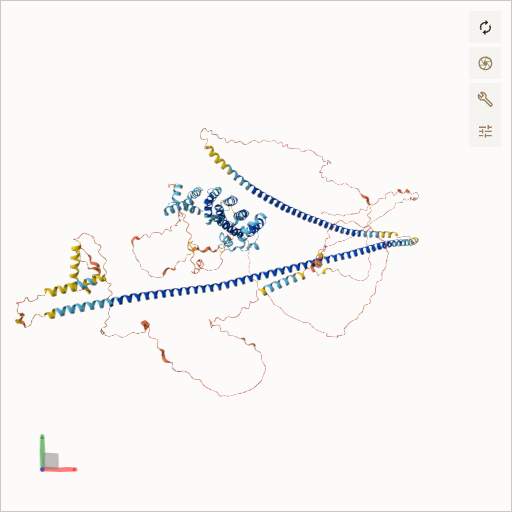
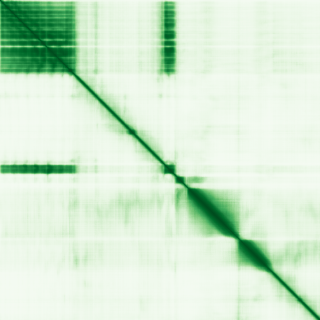
Mean pLDDT
62.1/ 100
Low
1,164 residues
Confidence breakdown
- Very high(≥ 90)25%
- Confident(70–90)23%
- Low(50–70)10%
- Very low(< 50)43%
Open interactive 3D viewer
AlphaFold (Jumper et al., 2021) · CC BY 4.0
TSC complex subunit 1
Annotations refreshed 2 months ago.
Diagnostic Grade (Green)
Adult solid tumours cancer susceptibility
MONOALLELIC, autosomal or pseudoautosomal, imprinted status unknownAdult solid tumours for rare disease
MONOALLELIC, autosomal or pseudoautosomal, imprinted status unknownChildhood solid tumours
MONOALLELIC, autosomal or pseudoautosomal, imprinted status unknownChildhood solid tumours cancer susceptibility
MONOALLELIC, autosomal or pseudoautosomal, imprinted status unknownClassical tuberous sclerosis
MONOALLELIC, autosomal or pseudoautosomal, NOT imprintedCystic kidney disease
MONOALLELIC, autosomal or pseudoautosomal, NOT imprintedDDG2P
MONOALLELIC, autosomal or pseudoautosomal, imprinted status unknownEarly onset or syndromic epilepsy
MONOALLELIC, autosomal or pseudoautosomal, imprinted status unknown+16 more panels — install the extension to see the full list inline on any page.
tuberous sclerosis
isolated focal cortical dysplasia type II
tuberous sclerosis 1
lymphangioleiomyomatosis
urinary bladder cancer
urinary bladder carcinoma
Inherited cancer-predisposing syndrome
hereditary neoplastic syndrome
neurodegenerative disease
Seizure
Score is the Open Targets composite evidence score (0-1). Higher = stronger gene-disease association.
Hamartin
Non-catalytic component of the TSC-TBC complex, a multiprotein complex that acts as a negative regulator of the canonical mTORC1 complex, an evolutionarily conserved central nutrient sensor that stimulates anabolic reactions and macromolecule biosynthesis to promote cellular biomass generation and growth (PubMed:12172553, PubMed:12271141, PubMed:12906785, PubMed:15340059, PubMed:24529379, PubMed:28215400). The TSC-TBC complex acts as a GTPase-activating protein (GAP) for the small GTPase RHEB, a direct activator of the protein kinase activity of mTORC1 (PubMed:12906785, PubMed:15340059, PubMed:24529379). In absence of nutrients, the TSC-TBC complex inhibits mTORC1, thereby preventing phosphorylation of ribosomal protein S6 kinase (RPS6KB1 and RPS6KB2) and EIF4EBP1 (4E-BP1) by the mTORC1 signaling (PubMed:12271141, PubMed:24529379, PubMed:28215400, PubMed:33215753). The TSC-TBC complex is inactivated in response to nutrients, relieving inhibition of mTORC1 (PubMed:12172553, PubMed:24529379). Within the TSC-TBC complex, TSC1 stabilizes TSC2 and prevents TSC2 self-aggregation (PubMed:10585443, PubMed:28215400). Acts as a tumor suppressor (PubMed:9242607). Involved in microtubule-mediated protein transport via its ability to regulate mTORC1 signaling (By similarity). Also acts as a co-chaperone for HSP90AA1 facilitating HSP90AA1 chaperoning of protein clients such as kinases, TSC2 and glucocorticoid receptor NR3C1 (PubMed:29127155). Increases ATP binding to HSP90AA1 and inhibits HSP90AA1 ATPase activity (PubMed:29127155). Competes with the activating co-chaperone AHSA1 for binding to HSP90AA1, thereby providing a reciprocal regulatory mechanism for chaperoning of client proteins (PubMed:29127155). Recruits TSC2 to HSP90AA1 and stabilizes TSC2 by preventing the interaction between TSC2 and ubiquitin ligase HERC1 (PubMed:16464865, PubMed:29127155)
Curated MONDO disease pages that list TSC1 among their top associated genes.
TSC1 · Q92574
Mean pLDDT
62.1/ 100
Low
1,164 residues
Confidence breakdown
AlphaFold (Jumper et al., 2021) · CC BY 4.0