
AlphaFold predicted structure
UNG · P13051
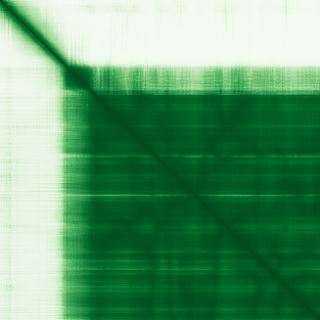
Mean pLDDT
85.3/ 100
Confident
313 residues
Confidence breakdown
- Very high(≥ 90)72%
- Confident(70–90)8%
- Low(50–70)4%
- Very low(< 50)16%
Open interactive 3D viewer
AlphaFold (Jumper et al., 2021) · CC BY 4.0
uracil DNA glycosylase
Annotations refreshed 3 months ago.
Diagnostic Grade (Green)
COVID-19 research
BIALLELIC, autosomal or pseudoautosomalPrimary immunodeficiency or monogenic inflammatory bowel disease
BIALLELIC, autosomal or pseudoautosomalhyper-IgM syndrome type 5
food allergy
Hereditary breast and ovarian cancer syndrome
hereditary breast ovarian cancer syndrome
neoplasm
infection
cancer
lymphoma
common variable immunodeficiency
BENTA disease
Score is the Open Targets composite evidence score (0-1). Higher = stronger gene-disease association.
Uracil-DNA glycosylase
Uracil-DNA glycosylase that hydrolyzes the N-glycosidic bond between uracil and deoxyribose in single- and double-stranded DNA (ssDNA and dsDNA) to release a free uracil residue and form an abasic (apurinic/apyrimidinic; AP) site. Excises uracil residues arising as a result of misincorporation of dUMP residues by DNA polymerase during replication or due to spontaneous or enzymatic deamination of cytosine (PubMed:12958596, PubMed:15967827, PubMed:17101234, PubMed:22521144, PubMed:7671300, PubMed:8900285, PubMed:9016624, PubMed:9776759). Mediates error-free base excision repair (BER) of uracil at replication forks. According to the model, it is recruited by PCNA to S-phase replication forks to remove misincorporated uracil at U:A base mispairs in nascent DNA strands. Via trimeric RPA it is recruited to ssDNA stretches ahead of the polymerase to allow detection and excision of deaminated cytosines prior to replication. The resultant AP sites temporarily stall replication, allowing time to repair the lesion (PubMed:22521144). Mediates mutagenic uracil processing involved in antibody affinity maturation. Processes AICDA-induced U:G base mispairs at variable immunoglobulin (Ig) regions leading to the generation of transversion mutations (PubMed:12958596). Operates at switch sites of Ig constant regions where it mediates Ig isotype class switch recombination. Excises AICDA-induced uracil residues forming AP sites that are subsequently nicked by APEX1 endonuclease. The accumulation of staggered nicks in opposite strands results in double strand DNA breaks that are finally resolved via non-homologous end joining repair pathway (By similarity) (PubMed:12958596)
UNG · P13051
Mean pLDDT
85.3/ 100
Confident
313 residues
Confidence breakdown
AlphaFold (Jumper et al., 2021) · CC BY 4.0