Skip to content
GenoLensGenoLens

WDPCP

Chr 2p15

WD repeat containing planar cell polarity effector

Aliases:
hFrtz, fritz, BBS15, CPLANE5
MANE:
ENST00000272321.12

Annotations refreshed 1 month ago.

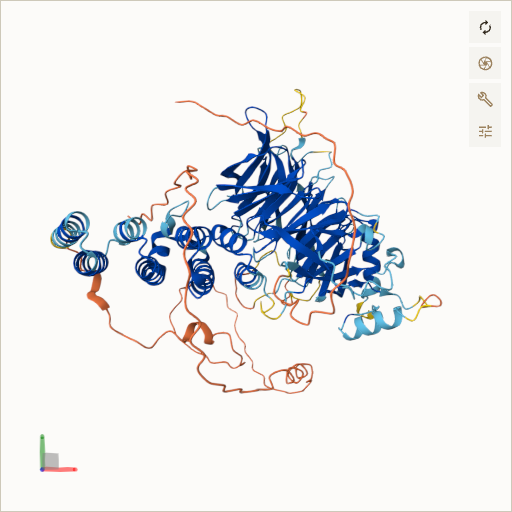
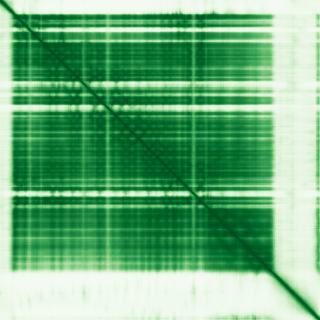
Predicted protein structure

Clinical relevance (Genomics England PanelApp)

Diagnostic Grade (Green)

  • DDG2P

    BIALLELIC, autosomal or pseudoautosomal
  • Fetal anomalies

    BIALLELIC, autosomal or pseudoautosomal
  • Intellectual disability

    BIALLELIC, autosomal or pseudoautosomal
  • Limb disorders

    BIALLELIC, autosomal or pseudoautosomal
  • Ophthalmological ciliopathies

    BIALLELIC, autosomal or pseudoautosomal
  • Rare multisystem ciliopathy disorders

    BIALLELIC, autosomal or pseudoautosomal
  • Renal ciliopathies

    BIALLELIC, autosomal or pseudoautosomal
  • Retinal disorders

    BIALLELIC, autosomal or pseudoautosomal

+13 more panels — install the extension to see the full list inline on any page.

Disease associations (Open Targets)

  • Bardet-Biedl syndrome 15

    0.72
  • Bardet-Biedl syndrome

    0.71
  • Heart defect-tongue hamartoma-polysyndactyly syndrome

    0.70
  • heart defect - tongue hamartoma - polysyndactyly syndrome

    0.67
  • Meckel syndrome

    0.52
  • hereditary disease

    0.47
  • prostate carcinoma

    0.45
  • orofaciodigital syndrome

    0.45
  • Bardet-Biedl syndrome 1

    0.38
  • ciliopathy

    0.38

Score is the Open Targets composite evidence score (0-1). Higher = stronger gene-disease association.

Protein function (UniProt)

WD repeat-containing and planar cell polarity effector protein fritz homolog

Probable effector of the planar cell polarity signaling pathway which regulates the septin cytoskeleton in both ciliogenesis and collective cell movements. Together with FUZ and WDPCP proposed to function as core component of the CPLANE (ciliogenesis and planar polarity effectors) complex involved in the recruitment of peripheral IFT-A proteins to basal bodies (By similarity). Binds phosphatidylinositol 3-phosphate with highest affinity, followed by phosphatidylinositol 4-phosphate and phosphatidylinositol 5-phosphate (PubMed:35427153)

Data sources: HGNC (CC BY 4.0), AlphaFold (CC BY 4.0, Jumper et al. Nature 2021), Genomics England PanelApp (CC BY 4.0), ClinGen, Open Targets (CC0), UniProt.

Not for sole clinical decision-making. Always verify against primary sources.