Skip to content
GenoLensGenoLens

WDR19

Chr 4p14

WD repeat domain 19

Aliases:
Pwdmp, KIAA1638, FLJ23127, ORF26, DYF-2
MANE:
ENST00000399820.8

Annotations refreshed 1 month ago.

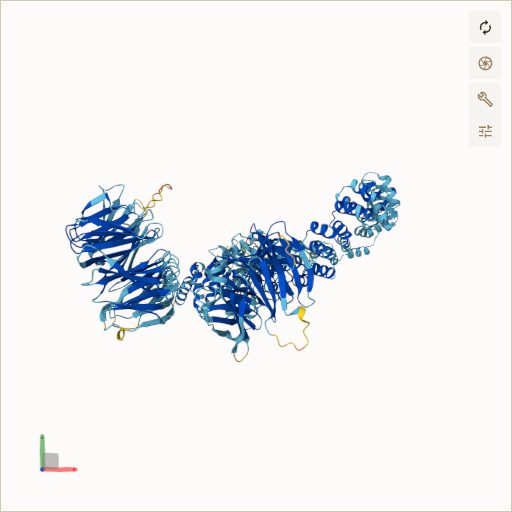
Predicted protein structure

Clinical relevance (Genomics England PanelApp)

Diagnostic Grade (Green)

  • Cystic kidney disease

    BIALLELIC, autosomal or pseudoautosomal
  • DDG2P

    BIALLELIC, autosomal or pseudoautosomal
  • Fetal anomalies

    BIALLELIC, autosomal or pseudoautosomal
  • Ophthalmological ciliopathies

    BIALLELIC, autosomal or pseudoautosomal
  • Rare multisystem ciliopathy disorders

    BIALLELIC, autosomal or pseudoautosomal
  • Renal ciliopathies

    BIALLELIC, autosomal or pseudoautosomal
  • Retinal disorders

    BIALLELIC, autosomal or pseudoautosomal
  • Skeletal ciliopathies

    BIALLELIC, autosomal or pseudoautosomal

+12 more panels — install the extension to see the full list inline on any page.

Disease associations (Open Targets)

  • Senior-Loken syndrome

    0.80
  • cranioectodermal dysplasia

    0.79
  • nephronophthisis

    0.77
  • Jeune syndrome

    0.74
  • asphyxiating thoracic dystrophy 5

    0.74
  • Senior-Loken syndrome 8

    0.70
  • spermatogenic failure 72

    0.61
  • Retinal dystrophy

    0.46
  • connective tissue disorder

    0.45
  • short-rib thoracic dysplasia 9 with or without polydactyly

    0.43

Score is the Open Targets composite evidence score (0-1). Higher = stronger gene-disease association.

Protein function (UniProt)

WD repeat-containing protein 19

As component of the IFT complex A (IFT-A), a complex required for retrograde ciliary transport and entry into cilia of G protein-coupled receptors (GPCRs), it is involved in cilia function and/or assembly (PubMed:20889716, PubMed:36775821). Essential for functional IFT-A assembly and ciliary entry of GPCRs (PubMed:20889716, PubMed:36775821). Associates with the BBSome complex to mediate ciliary transport (By similarity)

Curated MONDO disease pages that list WDR19 among their top associated genes.

Data sources: HGNC (CC BY 4.0), AlphaFold (CC BY 4.0, Jumper et al. Nature 2021), Genomics England PanelApp (CC BY 4.0), ClinGen, Open Targets (CC0), UniProt.

Not for sole clinical decision-making. Always verify against primary sources.