
AlphaFold predicted structure
WRN · Q14191
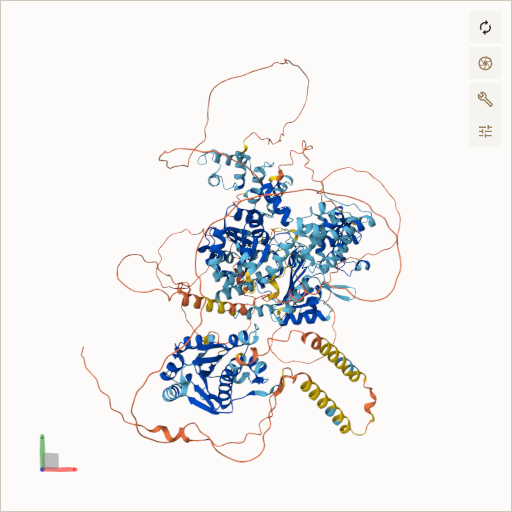
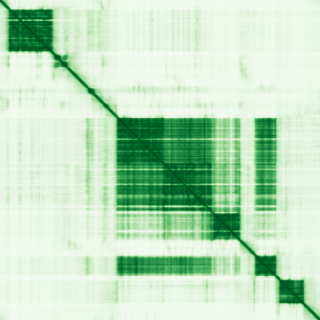
Mean pLDDT
68.6/ 100
Low
1,432 residues
Confidence breakdown
- Very high(≥ 90)28%
- Confident(70–90)33%
- Low(50–70)7%
- Very low(< 50)32%
Open interactive 3D viewer
AlphaFold (Jumper et al., 2021) · CC BY 4.0
WRN RecQ like helicase
Annotations refreshed 2 months ago.
Diagnostic Grade (Green)
Bilateral congenital or childhood onset cataracts
BIALLELIC, autosomal or pseudoautosomalChildhood solid tumours
BIALLELIC, autosomal or pseudoautosomalChildhood solid tumours cancer susceptibility
BIALLELIC, autosomal or pseudoautosomalInherited non-medullary thyroid cancer
BIALLELIC, autosomal or pseudoautosomalInsulin resistance (including lipodystrophy)
BIALLELIC, autosomal or pseudoautosomalIUGR and IGF abnormalities
BIALLELIC, autosomal or pseudoautosomalSarcoma of possible germline origin
BIALLELIC, autosomal or pseudoautosomalSevere insulin resistance and lipodystrophy syndromes
BIALLELIC, autosomal or pseudoautosomal+10 more panels — install the extension to see the full list inline on any page.
Werner syndrome
cancer
melanoma
thyroid gland carcinoma
gastric carcinoma
intelligence
ovarian cancer
prostate carcinoma
lung carcinoma
thyroid cancer
Score is the Open Targets composite evidence score (0-1). Higher = stronger gene-disease association.
Bifunctional 3'-5' exonuclease/ATP-dependent helicase WRN
Multifunctional enzyme that has magnesium and ATP-dependent 3'-5' DNA-helicase activity on partially duplex substrates (PubMed:9224595, PubMed:9288107, PubMed:9611231). Also has 3'->5' exonuclease activity towards double-stranded (ds)DNA with a 5'-overhang (PubMed:11863428). Has no nuclease activity towards single-stranded (ss)DNA or blunt-ended dsDNA (PubMed:11863428). Helicase activity is most efficient with (d)ATP, but (d)CTP will substitute with reduced efficiency; strand displacement is enhanced by single-strand binding-protein (heterotrimeric replication protein A complex, RPA1, RPA2, RPA3) (PubMed:9611231). Binds preferentially to DNA substrates containing alternate secondary structures, such as replication forks and Holliday junctions. May play an important role in the dissociation of joint DNA molecules that can arise as products of homologous recombination, at stalled replication forks or during DNA repair. Alleviates stalling of DNA polymerases at the site of DNA lesions. Plays a role in the formation of DNA replication focal centers; stably associates with foci elements generating binding sites for RP-A (By similarity). Plays a role in double-strand break repair after gamma-irradiation (PubMed:9224595, PubMed:9288107, PubMed:9611231). Unwinds some G-quadruplex DNA (d(CGG)n tracts); unwinding seems to occur in both 5'-3' and 3'-5' direction and requires a short single-stranded tail (PubMed:10212265). d(CGG)n tracts have a propensity to assemble into tetraplex structures; other G-rich substrates from a telomeric or IgG switch sequence are not unwound (PubMed:10212265). Depletion leads to chromosomal breaks and genome instability (PubMed:33199508)
Curated MONDO disease pages that list WRN among their top associated genes.
WRN · Q14191
Mean pLDDT
68.6/ 100
Low
1,432 residues
Confidence breakdown
AlphaFold (Jumper et al., 2021) · CC BY 4.0