
AlphaFold predicted structure
WT1 · P19544
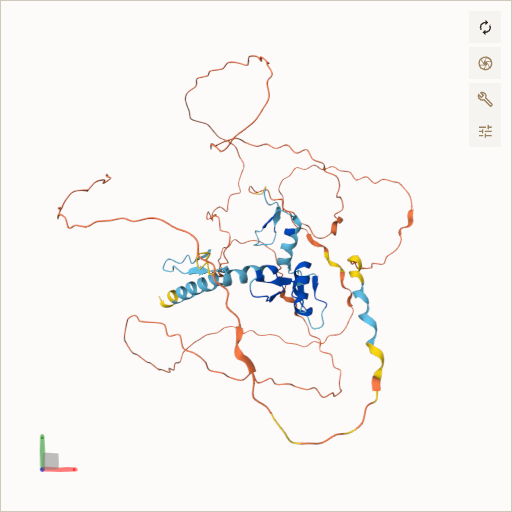

Mean pLDDT
50.8/ 100
Low
449 residues
Confidence breakdown
- Very high(≥ 90)9%
- Confident(70–90)19%
- Low(50–70)7%
- Very low(< 50)65%
Open interactive 3D viewer
AlphaFold (Jumper et al., 2021) · CC BY 4.0
WT1 transcription factor
Annotations refreshed 3 months ago.
Diagnostic Grade (Green)
Adult solid tumours cancer susceptibility
MONOALLELIC, autosomal or pseudoautosomal, imprinted status unknownAdult solid tumours for rare disease
MONOALLELIC, autosomal or pseudoautosomal, imprinted status unknownChildhood solid tumours
MONOALLELIC, autosomal or pseudoautosomal, imprinted status unknownChildhood solid tumours cancer susceptibility
MONOALLELIC, autosomal or pseudoautosomal, imprinted status unknownDDG2P
MONOALLELIC, autosomal or pseudoautosomal, imprinted status unknownDifferences in sex development
MONOALLELIC, autosomal or pseudoautosomal, NOT imprintedEmbryonal tumour of possible germline origin
MONOALLELIC, autosomal or pseudoautosomal, imprinted status unknownFetal anomalies
MONOALLELIC, autosomal or pseudoautosomal, imprinted status unknown+10 more panels — install the extension to see the full list inline on any page.
Denys-Drash syndrome
Wilms tumor 1
Frasier syndrome
nephrotic syndrome, type 4
Meacham syndrome
malignant mesothelioma
Nephroblastoma
familial idiopathic steroid-resistant nephrotic syndrome
Wilms tumor
WAGR syndrome
Score is the Open Targets composite evidence score (0-1). Higher = stronger gene-disease association.
Wilms tumor protein
Transcription factor that plays an important role in cellular development and cell survival (PubMed:7862533). Recognizes and binds to the DNA sequence 5'-GCG(T/G)GGGCG-3' (PubMed:17716689, PubMed:25258363, PubMed:7862533). Regulates the expression of numerous target genes, including EPO. Plays an essential role for development of the urogenital system. It has a tumor suppressor as well as an oncogenic role in tumor formation. Function may be isoform-specific: isoforms lacking the KTS motif may act as transcription factors (PubMed:15520190). Isoforms containing the KTS motif may bind mRNA and play a role in mRNA metabolism or splicing (PubMed:16934801). Isoform 1 has lower affinity for DNA, and can bind RNA (PubMed:19123921)
Curated MONDO disease pages that list WT1 among their top associated genes.
WT1 · P19544
Mean pLDDT
50.8/ 100
Low
449 residues
Confidence breakdown
AlphaFold (Jumper et al., 2021) · CC BY 4.0