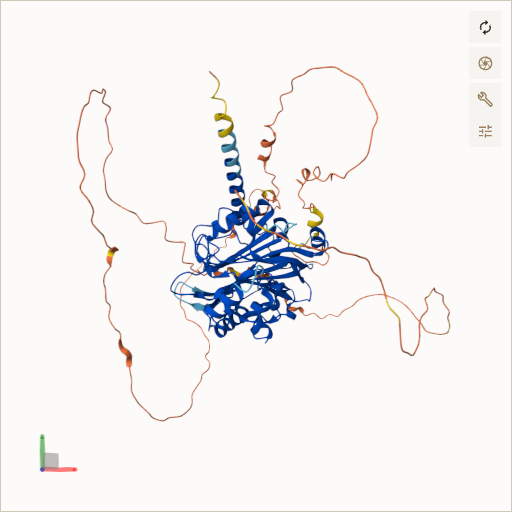
+9 more panels — install the extension to see the full list inline on any page.
Disease associations (Open Targets)
Joubert syndrome 1
0.83
Joubert syndrome
0.80
MORM syndrome
0.75
Joubert syndrome and related disorders
0.52
Retinal dystrophy
0.49
Rod-cone dystrophy
0.42
Joubert syndrome with ocular defect
0.38
Joubert syndrome with hepatic defect
0.38
hereditary disease
0.38
skin cancer
0.36
Score is the Open Targets composite evidence score (0-1). Higher = stronger gene-disease association.
Protein function (UniProt)
Phosphatidylinositol polyphosphate 5-phosphatase type IV
Phosphatidylinositol (PtdIns) phosphatase that specifically hydrolyzes the 5-phosphate of phosphatidylinositol-3,4,5-trisphosphate (PtdIns(3,4,5)P3), phosphatidylinositol 4,5-bisphosphate (PtdIns(4,5)P2) and phosphatidylinositol 3,5-bisphosphate (PtdIns(3,5)P2) (By similarity) (PubMed:10764818). Specific for lipid substrates, inactive towards water soluble inositol phosphates (PubMed:10764818). Can also remove the 5-phosphate from 1D-myo-inositol 1,4,5-trisphosphate (Ins(1,4,5)P3) (PubMed:40969890). Plays an essential role in the primary cilium by controlling ciliary growth and phosphoinositide 3-kinase (PI3K) signaling and stability (By similarity)
Diseases associated with INPP5E
Curated MONDO disease pages that list INPP5E among their top associated genes.