Skip to content
GenoLensGenoLens

MKS1

Chr 17q22

MKS transition zone complex subunit 1

Aliases:
FLJ20345, POC12, BBS13
MANE:
ENST00000393119.7

Annotations refreshed 1 month ago.

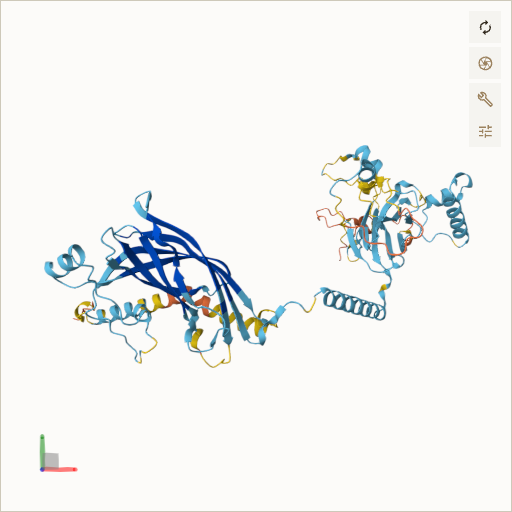
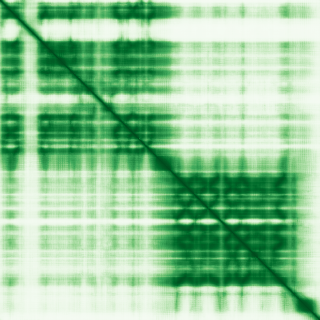
Predicted protein structure

Clinical relevance (Genomics England PanelApp)

Diagnostic Grade (Green)

  • Bardet Biedl syndrome

    BIALLELIC, autosomal or pseudoautosomal
  • Clefting

    BIALLELIC, autosomal or pseudoautosomal
  • DDG2P

    BIALLELIC, autosomal or pseudoautosomal
  • Fetal anomalies

    BIALLELIC, autosomal or pseudoautosomal
  • Intellectual disability

    BIALLELIC, autosomal or pseudoautosomal
  • Limb disorders

    BIALLELIC, autosomal or pseudoautosomal
  • Neurological ciliopathies

    BIALLELIC, autosomal or pseudoautosomal
  • Ophthalmological ciliopathies

    BIALLELIC, autosomal or pseudoautosomal

+17 more panels — install the extension to see the full list inline on any page.

Disease associations (Open Targets)

  • Bardet-Biedl syndrome

    0.78
  • Joubert syndrome

    0.77
  • Meckel syndrome

    0.77
  • Bardet-Biedl syndrome 13

    0.75
  • Meckel syndrome, type 1

    0.73
  • Joubert syndrome 28

    0.70
  • polydactyly

    0.66
  • polycystic kidney disease

    0.53
  • occipital encephalocele

    0.53
  • renal fibrosis

    0.53

Score is the Open Targets composite evidence score (0-1). Higher = stronger gene-disease association.

Protein function (UniProt)

Tectonic-like complex member MKS1

Component of the tectonic-like complex, a complex localized at the transition zone of primary cilia and acting as a barrier that prevents diffusion of transmembrane proteins between the cilia and plasma membranes. Involved in centrosome migration to the apical cell surface during early ciliogenesis. Required for ciliary structure and function, including a role in regulating length and appropriate number through modulating centrosome duplication. Required for cell branching morphology

Curated MONDO disease pages that list MKS1 among their top associated genes.

Data sources: HGNC (CC BY 4.0), AlphaFold (CC BY 4.0, Jumper et al. Nature 2021), Genomics England PanelApp (CC BY 4.0), ClinGen, Open Targets (CC0), UniProt.

Not for sole clinical decision-making. Always verify against primary sources.